Discuss Formation of a Burman State
State Counsellor of Myanmar Aung San Suu Kyi
Press conference reveals
call for army to withdraw
Discuss Formation of a Burman State
In the past, the Burma Army was opposed to federalism, but not anymore—they accept it nowMore
The Union Peace Conference as it is now called -- previously dubbed the 21st Panglong
Planned "Panglong" peace summit at the end of August...More
We do not have demands and offers. Everyone has a responsibility to make the country more developed..
We have to ask by what means some groups can participate in the review of the framework dialogue without signing the nationwide ceasefire agreement..More
Kachin civil society groups call for army to withdraw
The attack prompts the question from civilians whether the Tatmadaw (Burma Army) wants peace or not...More
Showing posts with label KAREN. Show all posts
Wednesday, July 8, 2015
Continued Fighting Makes Highway Travel Deadly
Categories :
Burmese Army . DKBA . KAREN . KNDO

Fighting between the Democratic Karen Benevolent Army and the Burma Army is continuing along the newly opened Asia Highway 1.
Nan Paw Gay had attended a preliminary Karen National Conference in Rangoon and hoping to return to the border area via Hpa-an.
“There was fighting on Sunday and officials had told us that there was still shooting today.”
Nan Paw Gar told Karen News that she was not the only one hoping to use the highway.
“I know of about 20 people who can’t get on the road. We are taking it as a day-by-day proposition – we considered using other routes, but were warned that the situation is tense in those areas as well.”
DKBA sources told Karen News that fighting between its troops and Burma Army soldiers continued through out the day – “both sides launched mortar attacks on each others positions for most of the day – about 30 rounds.There have been at least three DKBA soldiers wounded over the course of this conflict.”
Both the DKBA and the Burma Army have warned travellers not to use the either highways because of the fighting.
Fighting between government troops and soldiers from the Democratic Karen Benevolent Army on the new Myawaddy – Kawkareik Asia Highway broke out on Thursday morning, on the 2nd July.
Sources told Karen News that the conflict erupted over security for the highway and the increased number of Burma Army soldiers scheduled to be deployed in the area. Karen army sources told Karen News that the fighting was an attempted by the government to move the DKBA out of the area and take control of its territory. The head of the Karen National Defence Organisation, Major General Nerdah Bo Mya, told Karen News that fighting would continue unless the Burma Army is willing to negotiate a political solution.
“The DKBA are Karen and it’s Karen land – they have the right to stay there. The fighting will continue unless there is some sharing – the Burma Army have the right to share, but not the right to total control.”
http://karennews.org/2015/07/continued-fighting-makes-highway-travel-deadly.html/
This is Karen Land…We Have the Right To Stay…
Categories :
Burmese Army . KAREN . NEWS

As fighting continues between the Burma Army and Democratic Karen Benevolent Army, the government has come under fire from a senior Karen General for trying to “shut down the DKBA.”
Major General Nerdah Bo Mya, head of the Karen National Defence Organisation in an exclusive interview with Karen News said that the “Burma Army wanted the DKBA off the highway, they want the money and control over it.”
General Nerdah said that the “DKBA are Karen, it’s Karen land and they have the right to stay there. The Burma Army don’t have the right to tell Karen people what to do on their own land.”
General Nerdah told Karen News that the government troops had to learn to talk and share with ethnic people instead of resorting to military force.
“The Burma Army have the right to share, but not the right to take control and force the DKBA out – they have to learn negotiate not keep resorting to violence to try to get their way.”
General Nerdah said he saw little hope that the fighting would stop soon.
“The fighting will continue, unless the Burma Army are willing to share and to negotiate. If they try to kick the DKBA off their land it’s not a good sign for the on-going ‘peace-talks’ or building trust with ethnic people.”
From information from sources in the conflict areas, Karen News is led to understand that fighting has now spread to other areas of DKBA controlled territory – Kawkareik, Myawaddy and Hlaingbwe Township.
A mortar shell hit a school in Kawkareik 7:15am caused it to close. The DKBA denied the shell was theirs citing that its mortars did not have the capacity to fire that distance.
General Nerdah said that the conflict had the potential to escalate and to involve other ethnic armed groups.
“The DKBA are our brothers and if the Burma Army continues the fighting it will drag other Karen armed groups into the conflict. They [government] have to stop [fighting] if they want the peace process to continue.”
General Nerdah said it should not be difficult for international observers, to observe a pattern in what is happening in ethnic territories.
“The Burma Army is fighting in the north, using gunships, against the Kachin, the Kokang and the Shan and now they have moved their attacks down here in Karen State.”
General Nerdah responded to questions that the fighting in Karen State had nothing to do with security on the road.
“It’s nor about making the road safer. It’s about taking over Karen land, this is homeland, our territory, we have the right to be here.”
General Nerdah insisted to Karen News that the Karen did not want conflict.
“We don’t want to fight, but if they [Burma Army] keep violating the rights of the Karen we will respond. I want them to stop fighting, if not the KNDO will get involved.”
Fighting between government troops and soldiers from the Democratic Karen Benevolent Army on the new Myawaddy – Kawkareik Asia Highway broke out on Thursday morning, on the 2nd July.
General Nerdah explained that the government had a strategy for Karen State and it did not have the best intentions for its people.
“They want to control all our natural resources, its part of an overall plan that has included land confiscation. Karen people have the right to control the road in Karen State, not the government or its armed forces.”
General Nerdah was insistent that the KNDO had the right to stand by the Karen.
“Our responsibility is to protect the rights of the Karen people, if there rights are violated, we have the rights to defend them.”
General Nerdah warned that if the Burma Army is, “fighting one Karen armed group it affects all our groups.”
General Nerdah urged the government to stop fighting and to get back to the peace process and “if they are genuine about wanting a democracy they need to start a genuine political dialogue, not keep using these divisive tactics to take attention off a lack of commitment to share power with the ethnic people.”
The Burma Army did not respond to phone calls from Karen News for this story.
http://karennews.org/2015/07/this-is-karen-landwe-have-the-right-to-stay.html/
Wednesday, December 10, 2014
Karen Army General Explains Rational Behind Reformation Of Ethnic Alliance And Recent Conflict With Govt Troops

Karen News spoke exclusively with General General Baw Kyaw Heh, the Karen National Liberation Army’s Vice-Chief of Staff, explains about what the alliance between four Karen armed groups and what lies behind the recent outbreak of fighting.
For the sake of clarity, Karen News has provided General Baw Kyaw Heh’s answers in full.
Q: Who will lead the KAF?
A: The reunion of KAF is only the first of many steps in a process to reform the Karen security sector. Details of the structure and authority/leadership will be announced later. At this stage, KAF means a collaboration, coordination and reunion of different Karen armed forces. Each unit and command will be led by its current commander as usual.
Q: Why is there need for a KAF, Why not just one-armed force that already exists, like the KNLA?
A: In fact, KAF has already existed since the late 1940s. Soon after the Karen resistance started in 1949, Kawthoolei Arm Forces was formed in order to reorganize all Karen armed forces such as KNDO, Karen Rifle, UMP and police force etc. In this current political context, we found that KAF is the best neutral platform to bring together the different armed forces to cooperate and seek out the best solutions to support Karen national political aspirations, including how to best fit into the changing political landscape. The first step is the reunion and then the reform will follow.
Q: Is every part of each different group joining the KAF? Will the KAF represent 100% membership of each armed group?
A: As everyone can see, none of the different groups is monolithic, and this is due to internal and external political factors and geographical locations. This is the reason why we need KAF as an umbrella institution that they can turn to in times of military and/or political crisis. In the current extreme political climate, it is really challenging for the different armed group leaders to bring all groups on board in a short time. However, the joint agreement that we have initiated now represents an initial success in bringing some armed groups that have split from the KNU over the last two decades to reunite. The reunion can eventually lead us to better understanding and cooperation, and thus a true representation of all the members under the umbrella of KAF will emerge.
Q: What are your thoughts on the latest fighting in Karen State?
A: We are engaging in the peace process, and we are serious about it. However, we reserve our right to defend ourselves, as we have not solved any of the political problems yet. Militarily, the Burma Army knows that the Karen armed groups are trying to reunite under the leadership of KNU. When one of the armed groups is attacked and the other groups fail to respond and assist, it means the BA can divide and rule the armed groups like they always do. The recent BA attacks on the DKBA illustrates this. Politically, the government uses carrot-and-stick tactics in its strategy to get the armed groups to agree to its nationwide ceasefire terms. Economically, it is extremely important for the government and the Burmese army to gain 100% control over the Myawaddy-Hpa-An region in order to realize full economic integration in the ASEAN Economic Community (AEC) by 2015. The region is the only broken link in the east-west economic corridor, thus frustrating the economic dreams, not only of the Burmese government, but those of ASEAN as well. Other mega development projects such as the Asia Highway, SEZ and hydropower dams are on the horizon. The government always pushes to “accelerate development projects in tandem with peace” in conflict areas. Dividing, fighting, and crushing ethnic armed groups is the Burmese army’s shortcut on the road to peace and development.
Q: What will be the political organization representing the KAF?
A: All armed groups recognize the political leadership of the KNU, as well as its political goals. So, it is really important for the KNU to do more to truly represent the interests of all armed groups politically. This will be a work in progress because we must acknowledge that there are differences among and within the different groups. KNU, KNLA/PC, and DKBA have all signed separate ceasefire agreements with the government, so they each represent their own organization.
http://karennews.org/2014/10/karen-army-general-explains-rational-behind-reformation-of-ethnic-alliance-and-recent-conflict-with-govt-troops.html/
Dr. Cynthia Maung’s Plants 55 Trees and Calls on International Community to Continue Funding

Dr Cynthia founder of the Mae Tao Clinic on the Thai Burma border that provides free health care to as many 140,000 refugees and migrant workers from Burma each year celebrated her 55th birthday on Saturday 6 December by planting the same number of trees and called on the international community to continue funding border projects.
Dr Cynthia’s Mae Tao Clinic started life as little more than a shed. Today MTC has dozens of staff and treats tens of thousands of patients each year. Dr Cynthia because of her work has received more than 20 awards worldwide. Speaking at her birthday celebrations Dr Cynthia said.
“I would like to say that I am very happy that I could celebrate my birthday ceremony with my fellow workers, the local community leaders, the students, education organizations and women organizations. In particular, I am pleased that we can provide the education and healthcare services because of the support of the ethnic people, both from Burma and Thailand and also because of the support of the Thai people.
Dr Cynthia stressed that it was important for the international community to continue funding projects along the border.
“People along the border continue to receive humanitarian support from the international organizations, though this may change. I would like to say that, at the present time, people in the border areas still urgently need the support of international organizations in order to not only survive but live with dignity.”
Dr. Cynthia said that for the moment the border region still needed the financial support for the conceivable future as Burma’s threadbare health care and education system forced people across the border for help.
“We see that people from inside are receiving the support of the international organizations. We need short term and long term support – three years or five years is needed to establish strong ongoing education, healthcare service and livelihood support.”
Dr.Cynthia stressed that more people needed to be doing more good for the community.
“If more people get involved in the right way I believe that our country will get genuine democracy and will have a genuine federal state, we will be developed and we will become a country full of prosperity for the people.”
Attending Dr Cynthia’s birthday celebrations were representatives of the Karen National Union, Karen Youth Organization, Karen Women’s Organization, Thai authorities and many community based organisations and NGOs.
A total of over 300 people attended the ceremony and among those were students who performed traditional dance at the celebration while others delivered speeches. Dr Cynthia planted 55 trees, each one representing a year of her life, as a symbol of encouraging young people to take care of the environment.
http://karennews.org/2014/12/dr-cynthia-maungs-plants-55-trees-calls-international-community-continue-funding.html/
Wednesday, November 20, 2013
Burma army uses aid convoy to captures KIO controlled IDP camp

Burmese government soldiers.
Burma army troops took control of an internally displaced people's camp in southern Kachin state from the Kachin Independence Organization (KIO) on Saturday November 16th by taking advantage of an aid convoy which traveled to the area, according to KIO officials.
The camp based in Bhamo (or Manmaw) district's Nam Lim Pa was captured by 300 troops under Bhamo based Military Operation Command 21 (MOC-21), who entered the camp just minutes after a Catholic funded aid convoy reached the camp, according to Lahpai La Doi, an official with Kachin Independence Army's Battalion 12. The convoy which consisted of 10 vehicles was operated by the Karuna Myanmar Social Services (KMSS), the social development agency of the Catholic Church in Burma.
KIA forces did not resist the army's effort to seize the camp because doing so would have resulted in many civilians getting caught up in the cross fire, Lahpai La Doi said.The camp based in Bhamo (or Manmaw) district's Nam Lim Pa was captured by 300 troops under Bhamo based Military Operation Command 21 (MOC-21), who entered the camp just minutes after a Catholic funded aid convoy reached the camp, according to Lahpai La Doi, an official with Kachin Independence Army's Battalion 12. The convoy which consisted of 10 vehicles was operated by the Karuna Myanmar Social Services (KMSS), the social development agency of the Catholic Church in Burma.
When the soldiers arrived at Nam Lim Pa, IDP and local villagers fled to a nearby forest leaving their belongings behind, Lahpai La Doi said. Few if any of the IDP have returned to the camp. Some are believed to be headed for another KIO controlled camp at Nbapa or a government controlled camp at Man Win near the China border but as of Monday none of the displaced had reached the other camps according to aid workers.
The incident on Saturday is not the first the army has used aid convoys to capture more territory. Earlier this year the Myanmar Times citing a leaked UN memo reported that the military had taken advantage of UN aid convoys in Kachin state's jade rich Hpakant to send in troops and capture territory from the KIO. The memo penned by a senior UN official directing the UN’s relief program in Kachin State described “trucks with government soldiers taking advantage of the passage of the aid convoy to take new positions”.
Heavy fighting begins near camp after army takeover
Heavy fighting broke out around Nam Lim Pa camp shortly after government forces took control of the camp, said Major Labang Jawn Awng, a commander with KIA battalion 12 during a phone interview with the Kachin News Group.
The fighting began at Nam Lim Pa and Mahkaw Yang on Sunday morning and lasted until midnight, commander Jawn Awng told the Kachin News Group. The fighting then continued on Monday morning at nearby Kawng Ja Yang village.
“There are now there no more civilians in our battalion 12 area just us (KIA forces) and Burmese troops. More clashes will likely break out at any moment,” he said.
More than 1,000 government troops from 20 battalions under MOC-21 (Bhamo) under Myitkyina-based Northern Regional Military Command and MOC-16 (Theinni or Hsenwi) under Lashio-based Northeast Regional Military Command are currently operating against KIA battalion 12, according to Commander Jawn Awng.
Sunday, September 29, 2013
Military Assistance to Myanmar – A Need for Balance
Categories :
The United States and Australia need to adopt a calibrated approach in extending military assistance to the new leadership in Myanmar. Without such a calculated framework, Washington’s efforts at building partner capacity will be much less effective.
Since 2012 the United States, followed by Australia, has extended military assistance and relaxed restrictions on defence cooperation to Myanmar. Then Secretary of Defence Leon Panetta announced that the US would extend military assistance to Myanmar if the leadership continued to implement democratic reforms and improve human rights conditions. Within a year the then Australian prime minister Julia Gillard announced a relaxation of restrictions on defence co-operation with Myanmar in recognition of its “critical reforms”. Australia wanted to encourage the development of a modern, professional defence force in Myanmar which continued to support democratisation and reform, she said.
Building partners’ capacity
To date, this has meant Myanmar sending observers to the annual Cobra Gold exercise involving American and Thai forces. This decision to extend to Myanmar what is commonly referred to as Building Partner Capacity (BPC) is part of a larger effort to help promote its evolution toward a more professional force under civilian control. However some caution is called for by Washington in regard to the amount of BPC funds it invests. As a recent RAND report Building Partner Capacity: What Works Best and Under What Circumstances noted, BPC efforts tend to be most effective with countries that share US security interests, have high governance indicators, a strong and growing economy, and are willing to invest their own funds to sustain capacity-building. US BPC areas have included border security, counter-insurgency, counter-narcotics, coalition operations, maritime security, and defence institution building. The US had halted all co-operation with Myanmar’s military in the 1990s because of its bad human rights record, but has recently been lifting sanctions in response to democratic reforms in the country. Some Australian scholars have argued that careful engagement and training by countries like Australia can expose the Myanmar armed forces to international norms and promote new ways of thinking.
It is certainly true that greater BPC engagement can itself help improve bilateral relationships. However, it is arguable that unless overall changes in Myanmar’s governance continue and are sustained, then US and Australian BPC efforts will not be as effective. As the historical record shows, a political leadership has to want to change for those efforts to bear fruit.
Tatmadaw’s human rights abuses
While more western BPC funding would certainly have positive results, and indeed economic and military assistance might help bring about long-term change, still development, investment, and training should be specified, targeted, and afforded based on specific and incremental goals. For example, Australia and the US could first provide military education and training on the rules of engagement and conduct – and wait to see tangible results of such training – before deciding on further military cooperation. That is what happened with Indonesia. In 1999 the US Congress terminated most of its military assistance funding to Indonesia after its military committed human rights abuses in East Timor. Funding resumed in 2002, with US assistance focusing heavily on strengthening Indonesia’s capacities to combat regional and international terrorism. Assistance went towards enhancing professionalism, increasing exposure to US norms of civil-military relations, defence budget formulation, military reform and respect for international standards of human rights. In Myanmar this will mean the leadership will have to make serious efforts to address the human rights abuses still being committed by the Tatmadaw. One example of alleged human rights abuses is the Myanmar Army’s systematic use of rape against ethnic women in the border areas as an instrument of war. Numerous reports produced by local organisations such as the Karen Women’s Organisation (KWO), Shan Women’s Action Network (SWAN), and the Kachin Women’s Association of Thailand (KWAT), as well as the United Nations and international non-government organisations, detail the widespread sexual violence in militarised areas.
Need for new benchmarks
A recent report in September last year, “State Terror in the Kachin Hills”, by the Kachin Women’s Association of Thailand (KWAT) details the experiences of 26 civilians, including women and children, who suffered from alleged abuse by the Myanmar military since last September. KWAT has also reported at least 64 cases of rape and sexual assault in Kachin State. According to the reports many of these crimes are allegedly being committed by senior military officers. Even though Myanmar is a signatory to the 1949 Geneva Convention, there are no indications the government has taken any initiatives to enforce international humanitarian laws amongst its army. Indeed there are very few known cases of military personnel being punished for such acts. Although it is in Washington’s and Canberra’s interests to develop a positive relationship with the national government and promote democratic reform, military assistance and BPC funding have to be contingent on meeting certain benchmarks in civil-military relations, military professionalism, addressing human rights violations, and overall democratic governance in Myanmar. Reforms might include creating a strong civilian police force that could pose a counter-balance to the internal security function of the military; removing military officers from key posts within government and ensuring that civilians are democratically elected into power; and liquidating socio-political compartments and functions within military structures. Another measure might include a clear delineation of security roles between standing armed forces, police, and other units. This would include placing the military under the authority of a civilian-led ministry of defence. Yet another would be to place limits on the number and geographic scope of the Tatmadaw near ethnic villages. On a broader societal level, there could be policies to ensure that the ethnic populations of Myanmar are duly represented in parliament. In April this year, the Union Solidarity and Development Party had even voted against a proposal to form a ministry of ethnic affairs. Military reforms should, after all, be a reflection of broader democratic transformations within a society.
*Christine M. Leah is currently a Visiting Research Fellow with the Military Transformations Programme at the S. Rajaratnam School of International Studies (RSIS), Nanyang Technological University and is a guest contributor to Karen News.
http://karennews.org/2013/09/military-assistance-to-myanmar-a-need-for-balance.html/
Thursday, August 30, 2012
KNU leader sees positive in Burma’s cabinet shuffle

The KNU leader told Karen News.
“I see a positive change. These newly appointed people are not regarded as narrow minded and self-serving. I think President U Thein Sein is a reformer who really wants there to be change.”
David Tharc Kapaw says he has done his own analysis of the recent reforms in Burma and that there will be power struggle between President Thein Sein’s government and the Burma Army.
David Tharc Kapaw points to the country’s 2008 Constitution that officially allows the Burma Army to automatically have 25% of seats in parliament.
President U Thein Sein announced a major cabinet reshuffle on Monday August 27 – promoting Railway Minister, U Aung Min, Industry Minister, U Soe Thein, National Planning and Economic Development Minister, U Tin Naing Thein, Finance and Revenue Minister U Hla Tun.
According to the President’s order ministers reassigned to new positions are – U Aung Kyi (From Ministry of Social Welfare, Relief and Resettlement to Ministry of Information), U Kyaw Hsan (From Ministry of Information to Ministry of Cooperatives), U Ohn Myint (From Ministry of Cooperatives and of Livestock and Fisheries to Ministry of Livestock and Fisheries), U Aye Myint (From Ministry of Science and Technology to Ministry of Industry), U Tint Hsan (From Ministry of Hotels and Tourism and of Sports to Ministry of Sports).
The Ministry positions are as follows:
1. U Soe Thein – Ministry of President Office (From Ministry of Industry)
2. U Aung Min – Ministry of President Office (From Ministry of Rail Transportation)
3. U Hla Tun – Ministry of President Office (From Ministry of Finance and Revenue)
4. U Tin Naing Thein – Ministry of President Office (From Ministry of National Planning and Economic Development)
5. U Aung Kyi – Ministry of Information (From Ministry of Social Welfare, Relief and Resettlement)
6. U Kyaw Hsan – Ministry of Cooperatives (From Ministry of Information)
7. U Ohn Myint – Ministry of Livestock and Fisheries (From Ministry of Cooperatives and of Livestock and Fisheries)
8. U Aye Myint – Ministry of Industry (From Ministry of Science and Technology)
9. U Tint Hsan – Ministry of Sport (From Ministry of Hotels and Tourism and of Sports)
Deputy ministers included the following:
1. Police Maj-Gen Kyaw Kyaw Tun (Ministry of Home Affairs)
2. U Paik Htwe (Ministry of Information)
3. U Than Swe (Ministry of Culture)
4. U Aung Thein (Ministry of President Office)
5. Dr Lin Aung (Ministry of Finance and Revenue)
6. U Hset Aung (Ministry of National Planning and Economic Development)
7. Dr Daw Khin San Yi (Ministry of National Planning and Economic Development)
8. Daw Su Su Hlaing (Ministry of Social Welfare, Relief and Resettlement)
9. U Thaung Tin (Ministry of Communications, Posts and Telegraphs)
10. U Htin Aung (Ministry of Energy)
11. Brig-Gen Win Myint (Ministry of Immigration and Population)
12. U Aye Myint Maung (Ministry of Environmental Conservation and Forestry)
13. Dr Daw Thet Thet Zin (Ministry of Environmental Conservation and Forestry)
14. U Thaung Htaik (Ministry of Sports)
15. Dr Daw Thein Thein Htay (Ministry of Health)
http://karennews.org/2012/08/knu-leader-sees-positive-in-burmas-cabinet-shuffle.html/
KNU make historic appearance at Hpa-an Karen Wrist-Tying ceremony

In what is considered a welcomed historic first by many Karen, the KNU celebrated the 35th anniversary of the wrist tying ceremony at Zwekabin Hall in Hpa-an Town that was organized by the Karen State Literature and Culture Committee on Sunday, 26th of August.
As many as 1,000 people attended the ceremony including Padoh Saw Ah Toe, the KNU Forestry Minister, Lieutenant Colonel Paw Doh, in-charge of the KNU’s Myawaddy Liaison Office, U Zaw Min, Chief Minister of Karen State, State Ministers, leaders of political parties, Members of Parliament and Karen civilians.
Mahn Myo Myint, one of the attended with the KNU spoke to Karen News.
“It is good the KNU leaders are having this chance to attend the wrist-tying ceremony – local people are welcoming and are happy to see them.”
Nan Say Awa – a Member of Parliament from the Plao Swaw Democratic Party said local people were pleased to see the KNU leaders, but still hesitated to be openly close.
“We are happy that they (KNU officials) attended the ceremony and all local Karen people are happy. But some people were afraid to talk to or communicate with the KNU. They are afraid because of article 17/1 is still active. I think people would have come closer and being more open if they were not classified as an illegal organization.”
The wrist-tying ceremony began at 10 am with a full program that included wrist tying, the singing of traditional songs, a public reception and many other traditional activities.
The Karen wrist-tying ceremony is a tradition eagerly anticipated each year and is celebrated widely by Karen communities around the world in an attempt to keep it alive.
Mahn Myo Myint said that this year’s ceremony is the point of hope for Karen to try achieve their common goal of peace.
“From this kind of Karen traditional ceremony where all Karen people gather together in unity, we hope that this will lead us to open discussion of our national issues. If this can happen, I think Karen people will achieve their common goal in the near future.”
According to local sources, the Karen State Chief Minister, U Zaw Min, contributed one-million-kyat and the KNU contributed 300,000 kyat to the Karen State Literature and Culture Committee for the organizing and holding of the ceremony.
The Karen wrist-tying ceremony handed down by Karen ancestors to be held on the Karen month of Lah Khu [the Burmese month of Wagaung or August). Historians claim the Karen’s ancestors believed that in order to protect their children, grandchildren or great grandchildren from harm from evil spirits, the elders must tie a piece of white thread on the wrists, while praying or chanting to drive the evil spirits away.
http://karennews.org/2012/08/knu-make-historic-appearance-at-hpa-an-karen-wrist-tying-ceremony.html/
KNU wants relocation of Burma Army high on peace-talk agenda

The KNU said in an official media statement it was disappointed that the Government’s representatives had confirmed the talks were off.
“The Karen National Union considers each step in the ceasefire negotiation process to be an opportunity to build trust between the parties. Such trust is essential to implement any ceasefire agreement. Therefore the Karen National Union calls upon the Government to move forward with the negotiations in a way that will build confidence and trust between the parties.”
The KNU have said the on-again third-round negotiations “will focus on the guarantee of safety for civilians and the building of trust progressively at every level of the negotiations.”
The KNU said in a statement today that the peace-talk meeting will also specifically look at two other items in the negotiations – “1) the systematic relocation of Burma Army soldiers from Karen State and, 2) a Code of Conduct, that was drafted by the KNU and submitted to the Burma Government for discussion.”
The KNU said in its official statement released today that “the endeavor to achieve a lasting peace after decades of armed conflicts and political disputes will be possible through the participation and support of all concerned parties and stakeholders.”
http://karennews.org/2012/08/knu-wants-relocation-of-burma-army-high-on-peace-talk-agenda.html/
Thursday, August 16, 2012
62nd Karen Martyr’s Day commemorated widely

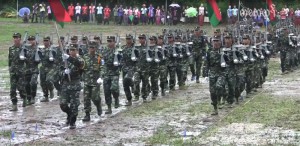
The commemoration ceremony was attended by as many as 400 people including members of the KNU and villagers from Noh Poe, Htee Mu Hta and Meh Ka Nae. Captain Hla Min, the Karen National Liberation Army, Brigade 6 Special Battalion Commander, said with pride that this was their first time in that area that they had a military parade included in the program.
“It is the ceasefire period and it is good we can have a military parade in Noh Poe village – to raise our patriotism and nationalism. In the past, we could only have a military parade in the jungle when we commemorated our Martyrs’ Day.”
Among those attending the event were Saw Popo Htoo Aung from the KNU’s Nyaunglebin District organizing department and Saw Eh K’Lu Say, Vice chairperson of the Karen Youth Organization who made speeches to the gathered people.
A young villager from Meh Ka Nae village told Karen News.
“This is my first time attending Martyrs’ Day held at Noh Poe village. It is an honor. I gained a lot of knowledge from listening to the speeches given by Karen leaders about our Martyrs’.”
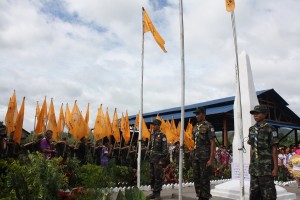
The commemoration program included the raising of the Karen flag to the half way to mark and honor the many lives that have been sacrificed, a military parade, honoring the families of the fallen and presenting a wreath to the Martyrs Pillar.
The Martyrs’ Day commemoration ceremony has been held 13 times at Noh Poe village. As well as a military parade, this year’s event also included a singing competition and a football competition that began on August 11.
Karen Martyrs’ Day was also held in the KNU’s Brigade 7 in Pa-an District and by the KloHtooBaw Karen Organization with its armed wing, the DKBA holding commemoration events at the Kaw Thoo Mwe Khee area in Myawaddy Township – as many as a thousand people attended. The 88 generation student leaders, Ko Mya Aye and Ko Htay Kywe were among those who attended the Karen Martyrs’ Day ceremony held in Kawkareik Township.
On the Thai-Burma border the 62nd Karen Martyrs’ Day was commemorated by students from Kaw Th’Blay School run by the Karen National Defense Organization.
Karen Martyrs’ Day marks the death of the first Karen national leader, Saw Ba Oo Gyi, who was killed on August 12, 1950 by the Burma Army. The Karen Martyrs Day was ratified during Karen Government on April 1951 and since its inception it has been commemorated – this is the 62nd year.
..............
http://karennews.org/2012/08/62nd-karen-martyrs-day-commemorated-widely.html/
‘Martyrs’ Day’ speeches warn government to keep its promise

The soldiers are on parade to commemorate August 12, the 62nd year of Karen ‘Martyrs’ Day’.” The soldiers are from the armed forces of the Karen National Union (KNU) and have gathered together with retired and serving soldiers, officers, military leaders and Karen civilian at the Karen National Liberation Army Brigade-7 jungle base to their fallen heroes.
Saw Aung Maw Aye, the KNU’s Pa-an District chairman addressed the gathered crowded.
“We cannot count the number of our precious leaders, soldiers and civilians who gave their lives for our people. Today we come here to remember and honor them and to let our next generation know that we are a [Karen] nation.”
Brigadier General Saw Johnny, the commander of Karen National Liberation Army (KNLA) Brigade 7, when speaking to the crowd said.
“We have been in revolution for 63-years. But we have not yet reached our goal of striving for ethnic equal rights and self-determination. First we have to unite all Karen factions and we have to cooperate with each other. If we are united we will achieve our goals.”
The Karen Martyrs’ Day is commemorated each year on August 12, the day when the Burma Army killed the Karen’s leader, Saw Ba U Gyi, in 1950. The Karen Martyrs’ Day is held to commemorate the Karen leader Saw Ba U Gyi and all leaders, soldiers and Karen people who lost their lives in the arm conflict between the various Burma governments and the Karen people over the last six decades.
In the past six decades of arm conflict between the KNU and Burma’s military governments there have been attempts to reach a ceasefire, but have been unsuccessful until ‘peace-talks’ in January this year. For the first time in a cease-fire agreement was signed. Brigadier General, Saw Johnny, told Karen News.
“Now we have a cease-fire with the government, but it is not sustainable yet. When it sustainable we will move to a political resolution. Conflict between the Karen and Burma government is an issue for all of Burma, it is also an issue for all ethnic groups, it is the major political issue for Burma. The government does not want to resolve the ethnic conflict by political mean, but with violence and with guns. There has been bloodshed for over 60 years. For 63 years they failed to destroy the Karen people by using weapons.”
Brigadier General, Saw Johnny, said it is up to the government to honour its commitment and promises to the peace process and he warned.
“We are monitoring, if the government does what it has promised we should not have a problem. But we will still retain our arms. If they don’t do as they promised and if the cease-fire is broken, it will not be the fault of the KNU – it will be the fault of the government.”
..................
http://karennews.org/2012/08/martyrs-day-speeches-warn-government-to-keep-its-promise.html/
Sunday, August 12, 2012
DKBA leader challenges Thai deputy PM over drug accusations
Categories :

In response to the Thai government’s action of including the DKBA leader on a list that also names him as one of the 25 most wanted drug dealers, General Saw Ler Pwe told the reporters at Kaw Thoo Mwe Khee Section in Walay area in Myawaddy Township that he is innocent and he has or his soldiers have ever been involved in the drug trade.
Saw Gon Aung, general secretary of the DKBA’s political wing – Klohtoobaw Karen Organization (KKO) – told Karen News that General Saw Ler Pwe refutes the Thai government’s accusation and is prepared to take the matter to international courts. General Saw Ler Pwe told reporters at the press conference.
“I was never involved in drug trafficking or production. I am prepared to go to the international criminal court to stand trial and receive a sentence – even if I have used or given opportunities to anyone to do drug businesses.”
According to Saw Gon Aung, General Saw Ler Pwe, said at the press conference that he invited the Thai government to carry out an investigation related to the drug accusations at any of the DKBA bases but Thai government has failed to accept the offer.
Saw Ler Pwe also said that that the Deputy Prime Minister’s accusation made via a Thai television interview naming and accusing had hurt both Brigadier General Saw Ler Pwe and Burma. Saw Ler Pwe said at the press conference saying that even though Thai government doesn’t apologize to the DKBA, they should apologize to Burma’s President Thein Sein for the drug smear.
General Saw Ler Pwe said that he plans to organize a press conference for the international media and he will invite representatives from international drug suppression organizations to come and investigate the alleged crimes and to see who is really running drugs.
The DKBA released a statement earlier warning the Thai government that they would be held responsible for the damage their accusations had done to the reputation of their leader and the DKBA. Karen News also understood that there may be economic reprisals carried out by the DKBA such as disruption to cross border trade.
The Thai government announced on April 20, that the Office of the Narcotics Control Board (ONCB) was offering 12 million baht (US $388,000) reward for the capture of 25 of the country’s most-wanted drug dealers. The list included three people from Burma – Naw Kham from the Golden Triangle region, Yi Say from the Burmese town of Tachilek area and the DKBA’s General Saw Ler Per from southern Karen state.
Landmines still widely used in Eastern Burma, says report
Categories :

In Eastern Burma, villagers are increasingly unwilling to leave their homes from fear of walking on a landmine, or of being coerced into becoming human minesweepers for the Burma Army.
A humanitarian NGO, the Karen Human Rights Group, has released a report documenting the challenges posed by the widespread employment of landmines in Eastern Burma – landmines are used by both ethnic non-state armed groups and Burma’s military.
The report entitled Uncertain Ground: Landmine use in Eastern Burma, focused on the period from January 2011 to May 2012 and used over a hundred oral testimonies, and included photos and interviews.
Ma Nu, a 33 year-old woman from Pa’an district, was blown up by a landmine whilst walking home in April this year. At the time she was seven months pregnant. She was fortunate she and her unborn baby survived the incident.
Burma’s army uses villagers as human minesweepers in contaminated zones. One horrific example dated February 4th 2012, describes how members of Burma’s elite military border guard force used villagers from Dewh Loh Township in Papun district as human minesweepers.
“They forced villagers to walk at the front of the column of soldiers, so they would step on landmines along the road instead of the soldiers.”one of the villagers when interviewed by the KHRG, “some of the villagers had their legs blown off,” he added.
The KHRG also warns that the clearing of landmine zones can open up local villages to the mercy of Burma’s military or armed ethnic rebel groups, leading to cases of torture, forced labour and extortion.
“Humanitarian actors must recognise the interrelated nature of human rights abuse in Eastern Burma, and address the fact that landmine removal may facilitate other forms of abuse.” The KHRG stated.
In a 2011 report conducted by the humanitarian organisation Geneva Call, it was estimated that 5.2 million people live in areas contaminated by landmines in Burma.
Subscribe to:
Posts (Atom)